

In a small or medium-sized business, it is not uncommon for a single person to serve as a shareholder, director, and executive all at once. It makes sense: why involve multiple people when a single person knows the company, owns the equity, and manages day-to-day operations?
But as soon as an important decision comes up for discussion, one question changes everything:
“In what capacity am I acting?”
These three roles do not entail the same powers or the same responsibilities. Confusing them is one of the most common—and most costly—blind spots in SME governance.
A typically Belgian reality
Belgium’s entrepreneurial landscape is made up of small businesses. According to Statbel, 96% of companies were micro-enterprises in 2023 (fewer than ten employees). The SRL, meanwhile, dominates new incorporations: 97.5% of companies established between May 2024 and April 2025 were SRLs (Entrepreneur Barometer, Fednot).
In such tightly knit organizations, it’s natural to wear multiple hats. But wearing multiple hats doesn’t mean blurring the lines between them —each role comes with its own set of responsibilities and its own level of exposure.
Three roles, three approaches
- The shareholder—the owner of the company
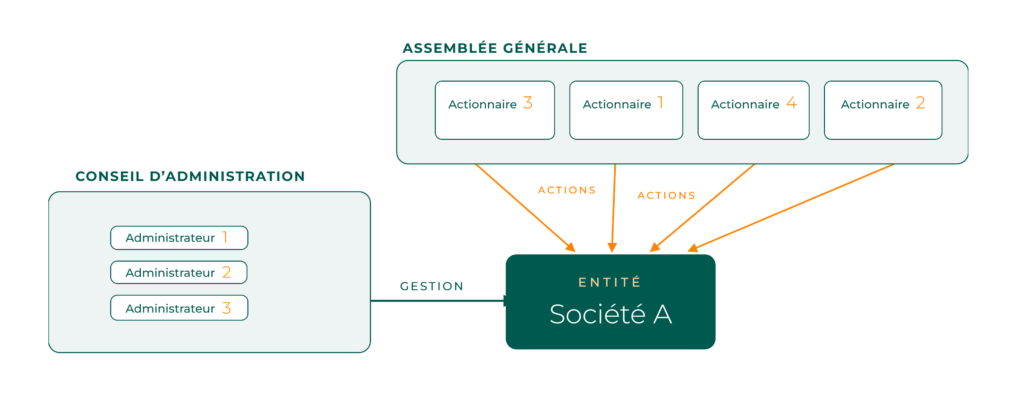
A shareholder owns all or part of the capital in exchange for his or her contribution. Their role is primarily related to ownership: at the shareholders’ meeting, they vote on matters such as the approval of the financial statements and the discharge of the directors, appoint the directors, and decide on matters that the law or the articles of incorporation reserve for the shareholders’ meeting.
In principle, a shareholder is liable for the company’s debts only to the extent of his or her capital contribution. The mere fact of being a shareholder does not, in and of itself, grant the shareholder the authority to manage the company on a day-to-day basis or to represent it. However, there is an important distinction regarding founders, who may be held liable under certain circumstances, as we will see below.
- The Administrator — to govern, to represent, to be accountable
The director serves on the board of directors, which has the powers necessary to achieve the corporation’s purpose—except for those powers reserved by law for the general meeting. Governance, strategic decisions, and legal representation: these are the director’s areas of expertise.
It is also the role most subject to scrutiny. A director may be held liable for mismanagement, violation of the law or the articles of incorporation, or tort liability toward a third party—as detailed below, since this is where holding multiple positions becomes a delicate matter.
- The Leader — Steering the Business
CEO, general manager, or other member of senior management: an operational role—managing teams, sales, and strategy execution.
A title does not tell the whole story about legal authority. To determine who can validly bind the company, one must examine the articles of incorporation, the rules governing representation, and any delegations of authority for day-to-day management. An officer who acts without such a delegation acts without the corresponding legal authority, even if no one disputes the legitimacy of their actions.
Sophie wears three hats
Sophie owns 70% of the shares in an LLC. She is also a director and CEO, and is one of the founders.
A supplier presents her with a major contract. She negotiates it with ease—that’s part of her operational role. But when it comes time to sign:
In what capacity is she signing? Does she have the authority to legally bind the LLC?
A few weeks later, a decision must be made regarding his own compensation. Another question arises: Who has the authority to make this decision, and is there a conflict of interest that needs to be addressed?
Holding multiple roles doesn’t make these issues go away—it makes them more significant, because each role presents Sophie in a different light.
And what if everything goes wrong: what happens to Sophie when one person has to handle it all?
When the same person is the majority shareholder, a board member, and the CEO, the instinct is to think, “It’s her company; she can do whatever she wants.” Legally speaking, that’s not true. If a problem arises, the question is never “Who is Sophie?” but rather “In what capacity was she acting when the disputed act was committed?” Holding multiple roles doesn’t merge those roles—it adds them together.
As a director, she may be held liable in three ways:
- Management misconduct —approving a transaction without due diligence, ignoring clear signs of trouble, or making a decision despite an unaddressed conflict of interest (such as one’s own compensation). Only the company can take action, and only a breach that clearly exceeds what a normally prudent director would have done can hold the director liable.
- Violation of the law or the articles of incorporation —which may be brought by the company or by third parties (such as a supplier). It is sufficient to prove the breach and the resulting damage.
- Tort liability —an injured third party may bring a claim directly against the company under general tort law.
If Sophie signs the contract without the required authority to act on behalf of the company, it is her capacity as a director or executive —not as a majority shareholder—that determines whether the agreement is valid.
As the founder, a separate exhibition has been added:
- If the SRL is declared bankrupt within three years of its incorporation, and if the initial equity capital was clearly insufficient to cover two years of normal operations, the founder may be held liable.
- Irregularities in the articles of incorporation (an inaccurate statement of purpose, a false statement regarding the capital) also render him liable.
In the event of bankruptcy: insolvency law establishes specific grounds for the trustee to intervene—gross and willful misconduct (lack of accounting records, significant misappropriation of funds, tax fraud), or continuing to operate a business with no prospect of recovery. A director involved in at least two bankruptcies within five years, each leaving unpaid social security debts, is also personally liable for these debts to the ONSS.
Please note: Directors’ liability is capped by law according to a scale based on revenue and total assets—ranging from €125,000 to €12 million. This makes liability insurance possible, even when directors hold multiple positions.
What remains unchanged : the shareholder’s rights remain protected—except in the two cases of founder liability described above.
Where SMEs Stumble
Confusing ownership with decision-making authority. Owning 70 percent—or even 100 percent—of the capital doesn’t mean you get to make all the decisions on your own.
Confusing a title with the power of representation. A CEO may have full operational autonomy without having the authority to sign all agreements on his or her own.
Informality. “We were all in agreement” is sufficient for day-to-day management. But certain decisions require a specific procedure or proper documentation—and it is the absence of such documentation that turns a disagreement into a demonstrable management failure.
This distinction becomes crucial during financing, an audit, due diligence, or a shareholder dispute.
Clarify Roles, Manage the Company More Effectively
Holding multiple positions in a Belgian small or medium-sized enterprise is not problematic in and of itself. The risk arises when the lines between ownership, governance, and operational management become blurred—because in the event of a dispute, these are precisely the areas that the court or the receiver will examine, one by one.
Good governance is not about bureaucracy. It is about knowing who decides what, in what capacity, and therefore who is accountable for what in the event of a mistake. This clarity becomes all the more critical as the company grows, brings in new shareholders, or seeks financing.